NATURAL LAW vs MAN-MADE LAW. THE ECONOMIC IMPACT OF THE COVID-19

Natural Law vs Man-Made Law. The Economic Fallout of the COVID-19.
Natural Law vs Man-made Law: The United States is governed by its supreme law called the Constitution of the United States of America which is founded on the principles of Natural Law.

December 19, 1998. President Clinton was impeached for the wrong reasons. His presidency can be described as ‘The Clinton Curse’.
In 1996, the US President Bill Clinton signed into Law the Welfare Reform Act popularly known as PRWORA. This man-made law divides the US workforce into two categories. 1. The native workers, and 2. the alien workers. The alien workers may use a Personal Identification Number (PIN) or Individual Taxpayer Identification Number (ITIN) to pay all taxes just like the native workers. However, they are not entitled to receive any of the public fund benefits. According to the IRS, in 2015, 4.35 million people paid over 13.7 billion in net taxes using an ITIN. ITIN holders are not eligible for all of the tax benefits and public benefits that U.S. citizens and other taxpayers can receive.
Natural Law vs Man-Made Law. The Economic Fallout of the COVID-19.
We cannot speak about the impact of COVID-19 in the US using universal terms. The impact is modified by man-made law. This unjust and unfair treatment of alien workers is a sinful action. The US may spend $2 trillion and more to blunt the attack by COVID-19. Because of the unfairness driving the country’s response, the nation may fail to reap the blessings of the LORD God Creator who made the man in His own image.

“We are far more connected with one another than we previously thought—not just because our jobs are connected with one another, not just because the value chains are spread throughout our countries, but because our lives are built in connection with one another. COVID-19 is dangerous because it exploits how close we have all become.“
COVID-19 is dangerous because it does not recognize the Man-Made Law. I demand Equal Justice Under Law.
Rudra Narasimham Rebbapragada
Special Frontier Force-Establishment No. 22-Vikas Regiment
Natural Law vs Man-Made Law. The Economic Fallout of the COVID-19.
COVID-19’S HISTORIC ECONOMIC IMPACT, IN THE U.S. AND ABROAD
As the epicenter of the coronavirus outbreak shifts from Italy to the U.S., SAIS Europe’s Filippo Taddei discusses the economic fallout Americans should brace for
ByHub staff report / Published 2 days ago
More than 2.1 million people around the world have become infected with COVID-19, and more than 140,000 people have died from the disease. The United States, now approaching 650,000 infections, is the new epicenter of the outbreak.
But as U.S. officials rush to contain the spread of disease, the federal government is also grappling with the dramatic—and unprecedented—toll the epidemic has had on the economy. In four weeks, 22 million Americans have filed for unemployment benefits. Technical glitches have prevented millions of Americans from receiving their stimulus checks from the U.S. Department of the Treasury. And the Small Business Administration, which supports U.S. entrepreneurs with loans and funding, has run out of money for its Paycheck Protection Program.
In fact, there is no country in the world that can be held up as a model for both its economic and public health response to the coronavirus pandemic.
For insights on how U.S. and European governments—and particularly Italy, the previous epicenter of the COVID-19 outbreak—have worked to contain the economic fallout from the global health crisis, the Hub turned to Filippo Taddei, a Johns Hopkins associate professor of international economics and a faculty member at SAIS Europe. The conversation has been edited for length and clarity.
Over the past several weeks we’ve seen central banks around the world, particularly the European Central Bank and the Federal Reserve, move with extraordinary speed to shore up financial markets, but these efforts have not calmed volatility. Is there anything else for central bankers to do, or is this an economic crisis that can only be solved through public health measures?
It is true that the size of the intervention is impressive. The size of the Federal Reserve’s intervention still remains higher than the ECB, and its promptness to act in the market has been much greater compared to the ECB. Perhaps this is not surprising since the ECB is a combination of the different central banks from EU member countries.
The real difference between the Federal Reserve and the ECB is how timely they have been in their responses. The U.S. started very strongly with a “preemptive strike”-style intervention, announcing a rate cut outside of the usual standard monthly meeting. Conversely, the president of the ECB held the usual press conference following the monthly meeting of the bank board, but her language wasn’t clear on how much the ECB would act in order to combat the global shock from the pandemic.
For central bankers, words often matter more than the actual money, so the wording of statements is crucial, especially at times like these. If we look at the uncertain start by the ECB and quick action by the Federal Reserve, in both cases the real difference is not about the money that central banks can put down, but rather how credible they can be to serve as an anchor against uncertainty.
This is a concern for everyone right now—we have a great degree of uncertainty in how long this pandemic will last, and that’s fundamental, unfortunately. What we don’t want is to add an additional layer of uncertainty about policy. The additional uncertainty is whether our institutions, like the ECB and other central banks, are willing to support the financial sector to make sure that credit keeps on flowing to the real economy, no matter what. This is not as obvious as it might sound: banks hold a large amount of government debt in their balance sheet and, whenever government bonds come under pressure, the increase in their yields threatens the stability of the banking system. When the ECB president asserted that the central bank’s job is not to ensure that Euro Area countries’ debt trades at low rates, she said something true but self-defeating. During such an unprecedented situation, the last thing a central banker should suggest is that an essential part of private banks’ assets could suffer, hindering their ability to operate and extend credit. Facing an unconventional shock, poor messaging and language is a huge drawback—the central banks need to be clearer so that their language matches the extraordinary moment that we’re facing.
The current economic crisis calls to mind the Great Recession of 2008 in terms of widespread damage, and some draw comparisons to the Great Depression of the 1930s. Do you feel these are accurate comparisons? Are there other precedents for what we’re experiencing, or is it a singular “black swan” event?
I don’t think these are the right comparisons because both crises—the Great Recession and the Great Depression—were essentially demand shocks. What you do with a demand shock is standard macroeconomic policy, and even allowing certain mistakes, we saw in the response to the Great Recession how fiscal and monetary policies worked to alleviate a demand shock.
This is something else. This is supply shock. Here, everything was functioning as normal, but as COVID-19 intensified, bringing thousands and then tens of thousands into the health system, we have decided to shut down the economy. This was because governments discouraged and then prohibited people going to work. If you think about it, supply is the measure of what we collectively produce, but the virus caused a sudden contraction of the labor supply. This has then caused a loss of confidence that resulted in a demand shock, too, but it’s a spillover, an indirect effect due to a fundamental contraction in our ability to produce goods and services.
When you face a supply shock, policies like those used during the Great Recession work, but only in containing the secondary shock to people’s confidence, the demand shock. It’s important to respond on the fiscal and monetary fronts. What’s really key is that we don’t add additional shocks on top of the initial crisis that is having such a severe effect on our ability to work and produce.
If you want to compare the current crisis to something that happened in the past, a better comparison is the oil shock and energy crisis during the 1970s and early 1980s. The sharp increase in the price of oil made the production and transportation of goods a lot more expensive, hindering productive capacity as is going on right now.
In the United States, relief efforts were initially stymied by a lack of consensus on how to allocate resources between working people and industry. How have EU countries navigated this tension, and are there lessons for U.S. lawmakers on crafting an effective stimulus response?
When you compare the policy situations in the EU and U.S., keep in mind that the EU is much more gradual in its adjustment. The U.S. is a country of choice and action, where things that seem unmovable before a crisis are suddenly thrown into flux—like the agreement on a $2 trillion stimulus bill. The EU is much more gradual in its approach. While the economic shock is common to all nations, it is not undertaken uniformly. So, what we’ve seen in Europe is an increasingly stricter response on the health front and an increasingly stronger economic support across the continent, but always undertaken in a gradual fashion.
Europe, and Italy in particular, can serve as a point of observation: if you are too gradual in your response, you run the risk of COVID’s course being worse than it might have otherwise have been. Really, Italy’s response made sense in the face of an unknown scenario, but perhaps we could have learned a little bit better from the events and responses in Asia. The clear message from our experience is that you need to intervene as swiftly and uniformly as possible. In light of the experience worldwide, one major concern for the U.S. is that different states are acting in different ways in trying to contain the virus.
What are the primary risks for Italy, other EU countries, and the U.S. as the economic crisis precipitated by COVID-19 continues?
Global productive capacity has shrunk severely and abruptly as a consequence of lockdown and some needed equipment, like ventilators, is in short supply. In normal times, the economy would quickly adjust by reallocating its workforce through new investments. This is simply impossible when people can’t effectively work due to the outbreak.
As overall production of goods and services is reduced, government action ensuring capacity to contain the epidemic as quickly as possible is justified if we want to bring people back to work. This type of policy action makes sense, and the crucial matter is to identify what is the most effective level of authority needed to aggressively address the outbreak. In any case, whether in the U.S. or in Europe, trying to convert production into what is immediately needed to end the outbreak is appropriate.
Italy has been encouraging this industrial conversion extensively as well, and so have other countries in Europe. There are different cases of companies that have started producing respirators, masks and protective garments, and other helpful medical supplies.
If we want to think of the long-term consequence of the COVID crisis, we should focus on public debt. The Great Recession left us with a legacy in the U.S. and EU of greatly expanded government debt. We think of the Great Recession as a temporary shock that we recovered from but now, as we look at the current crisis, we will be increasing government debt greatly compared to GDP. This is a legacy that will remain for a long time and will pose very pressing policy questions.
As we think about the future of advanced economies, in the U.S. and Europe, we have to ask ourselves how we will be dealing with a level of government debt that will exceed, as a share of GDP, the amount we had at the end of WWII. Our management of this new massive debt through the policy response in the aftermath of the crisis will shape our society determining the economic balance between generations, the actual opportunities for future generations, and the technological disruption and transformation that was already in place before this outbreak.
COVID-19 has had an unprecedented impact on labor, with the U.S. Treasury Secretary estimating that unemployment could reach 20% in the U.S. What are the long-term impacts, both in Europe and in the United States, of such severe unemployment?
We have to be careful not to pay too much attention to the unemployment rate alone as the crisis is also generating substantial underemployment: a large share of the workforce is not able to work as much as they could or wish. In Italy, to give you a sense of the labor situation, only somewhere between 40-50% of the labor force is able to work as efficiently as before. That means that between 50-60% of our workers are either working remotely or not working at all. It’s an unprecedented change in peace time, affecting everyone, not just the Italian economy.
There’s a large body of literature on the long-term consequences of unemployment, even when due to a short-term shock. When people lose their jobs, the long-lasting effects are not just on their income. Unemployment has a negative effect on workers’ skills and education, even on their health—people who are unemployed become sicker. Your human capital, the skills of your country’s workforce, decay over time because of the loss of jobs. To mitigate this, the Italian government is doing all it can to keep people as attached to their jobs as possible by preventing companies from enacting layoffs. In order to achieve this objective, short time compensation schemes—usually available only for large industrial firms—have been expanded to almost every sector and firm size. Through these schemes, the government pays reduced salaries, which allows employers to keep their employees without going bankrupt.
In the U.S. these schemes exist in more than 20 states but the country is less equipped in this dimension. U.S. workers experience a quicker turnover: they are laid off more often but then re-hired more quickly compared to the EU. The current scenario is different, though, from the usual business cycle because the current shock could discontinue many of these businesses altogether. What governments need to do at the moment is try to prevent the destruction of capital and desertification of existing businesses. Preventing employers from laying off people is likely to be in their and the economy’s best interest, even if they work very little, since this can help to better protect essential human capital. At the moment, the size of resources behind the relief package put in place by the U.S. government has surpassed the combined set of responses taken across Europe.
In the United States, public health officials have looked to Italy to anticipate future scenarios. Do you think this is an apt comparison? What lessons can leaders in the United States and other nations learn from the strategies taken by the Italian government?
Yes, it is a possibility, but there are a couple of lessons that Italy’s experience can provide in order to prevent or mitigate the outbreak we experienced.
The first is relatively easy: you have to test widely without limiting your attention only to the people showing symptoms. When you test people, keep them separated applying as much social distancing as possible. The U.S., where health care triage is much quicker, plays at an advantage here. These protocols might be more effective right now in containing the spread of the virus. A concern that we have seen in Europe is that if you don’t implement a response nationwide, containing the virus will be much harder. The response might not need to be exactly the same everywhere in the country, but you must require coordination and quick scalability. The U.S. must avoid the same mistake we had in Italy and the rest of Europe: if you don’t provide a coordinated response to containment, including possible restrictions to the movement and actions of people, the outbreak will only get worse. Make no mistake: this is costly economically, because production contracts sharply across the board, but if you can contain the outbreak in a shorter period of time, you will most likely end up congesting hospital capacity, increase the death toll and, eventually, extend the length of the economic shock.
We are far more connected with one another than we previously thought—not just because our jobs are connected with one another, not just because the value chains are spread throughout our countries, but because our lives are built in connection with one another. COVID-19 is dangerous because it exploits how close we have all become.

Natural Law vs Man-Made Law. The Economic Fallout of the COVID-19.
 In my analysis, the United States will not be able to support the military mission of Special Frontier Force without recognizing the McMahon Line in Kashmir. On behalf of Special Frontier Force I demand the United States to duly recognize the McMahon Line in Kashmir apart from recognizing it in Arunachal Pradesh to contain China’s military expansionism in Southeast Asia. In the past, China grabbed the Aksai Chin area of Kashmir taking the full advantage of the weakness of the US Policy in Southeast Asia.
Rudra Narasimham Rebbapragada
Special Frontier Force-Establishment No. 22-Vikas Regiment
In my analysis, the United States will not be able to support the military mission of Special Frontier Force without recognizing the McMahon Line in Kashmir. On behalf of Special Frontier Force I demand the United States to duly recognize the McMahon Line in Kashmir apart from recognizing it in Arunachal Pradesh to contain China’s military expansionism in Southeast Asia. In the past, China grabbed the Aksai Chin area of Kashmir taking the full advantage of the weakness of the US Policy in Southeast Asia.
Rudra Narasimham Rebbapragada
Special Frontier Force-Establishment No. 22-Vikas Regiment
 Principal Deputy Assistant Secretary for South and Central Asian Affairs Alice Wells: Discussion on India and the Indo-Pacific
REMARKS
THE ATLANTIC COUNCIL
WASHINGTON, DC
Principal Deputy Assistant Secretary for South and Central Asian Affairs Alice Wells: Discussion on India and the Indo-Pacific
REMARKS
THE ATLANTIC COUNCIL
WASHINGTON, DC
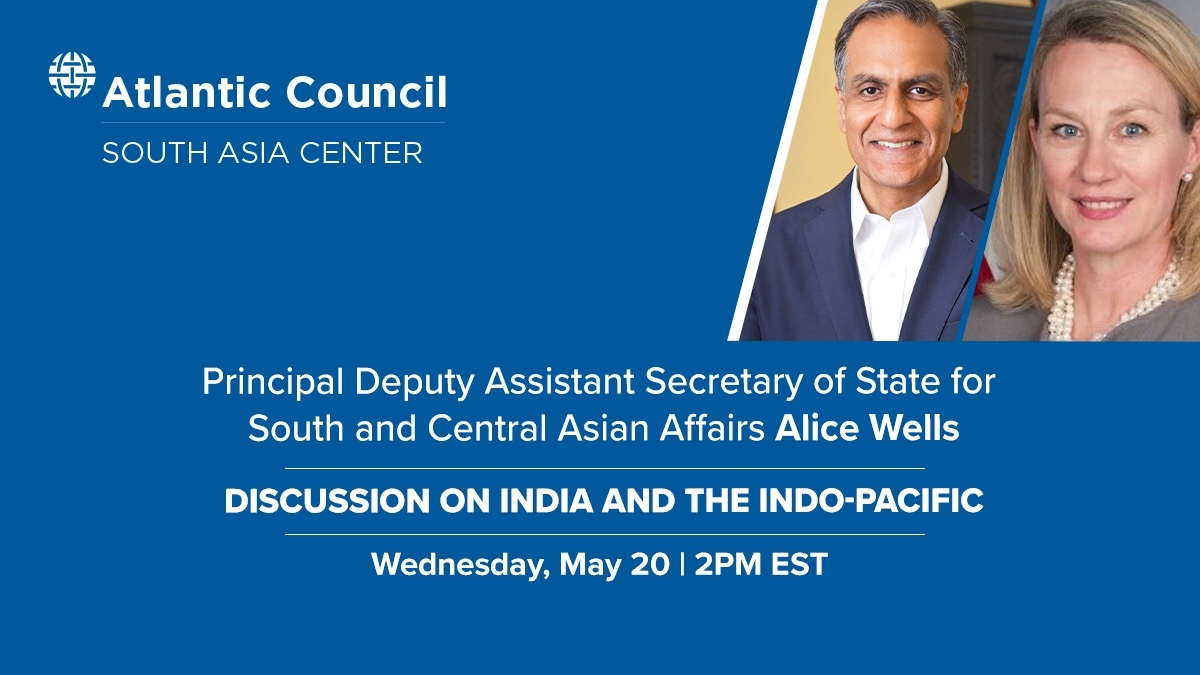 Mr. Kempe: Hello, everyone. I’m Fred Kempe. I’m President and CEO of the Atlantic Council and I’m delighted to have you in this virtual room with two of my favorite people, and I’ll get to that in a second, but there are not two more people more knowledgeable in their fields or more accomplished in their work as diplomats.
We talk a lot about social distance. We like to call it Atlantic Council geographic distance because we feel through these meetings we can bring all of you closer together socially and intellectually.
As a reminder, today’s meeting, which is a discussion on India and the Indo-Pacific, is public and on the record.
We are fortunate today to be joined by Ambassador Alice Wells, Principal Deputy Assistant Secretary of State for South and Central Asian Affairs. We’re especially grateful to host Ambassador Wells today. She will be retiring after an enormously distinguished 31 year career serving as a diplomat with the U.S. Department of State this Saturday.
Ambassador Wells assumed her duties as Acting Assistant Secretary for South and Central Asia in June 2017. I’m delighted to say that the Atlantic Council has had the good fortune of working with her and hosting her several times during this tenure.
Prior to her current post, Ambassador Wells served as the U.S. Ambassador to the Kingdom of Jordan, one of the most important positions in that region; a Senior Advisor in the Near Eastern Affairs Bureau in Department of State; Special Assistant to the President for Russia and Central Asia; and much more. During her time in the Foreign Service she served in U.S. embassies in New Delhi, Islamabad, in Riyadh. In short, she knows the world and she knows her stuff.
Alice, please allow me once again to thank you for your distinguished service.
We’re also joined by Ambassador Richard Verma, Vice Chair and Partner to the Asia Group and former U.S. Ambassador to India from 2014 to 2017.
Ambassador Verma has a distinguished career also over the past 25 years, serving across the U.S. government as Assistant Secretary of State for Legislative Affairs, Senior National Security Advisor to the Senate Majority Leader, and as Judge Advocate in the U.S. Air Force.
Our two participants, as I said earlier, are two of the most knowledgeable and accomplished individuals working on India and the Indo-Pacific. I look forward, as we all do on this virtual call, to your conversation. So Alice, Rich, it’s a pleasure to know you and it’s going to be a great pleasure to listen to you.
I think Alice, you’re going to kick us off, Ambassador Wells will kick us off with some opening remarks, and then we’ll ask Rich to moderate the event.
Ambassador Verma:
Let me turn to another frankly tense issue which is the border standoff. As you noted, Indian and Chinese forces often coming into contact with each other perhaps more frequently, even in the last week or so additional security challenges on that front. How much does that worry you? Can you give us a sense, are there de-escalatory measures that can be taken? This 2200 mile contested border presents some real security challenges for the Indian side.
Ambassador Wells: I think for anyone who was under any illusions that Chinese aggression was only rhetorical, I think they need to speak to India where India on a weekly, monthly, but certainly a very regular basis has to experience the pinpricks of Chinese military. It’s a reminder of what’s at stake in building a world order and sustaining a world order that respects sovereignty, territorial integrity, as well as respects the rules of international trade that have allowed, again, so many hundreds of millions to be lifted out of poverty.
We in the United States recognize the McMahon Line.
We’ve always recognized Arunachal Pradesh as an Indian state. We certainly urge India and China on the Line of Actual Control to engage diplomatically to resolve any outstanding differences. But this is, if you look to the South China Sea, there’s a method here to Chinese operations and it is that constant aggression, the constant attempt to shift the norms, to shift what is the status quo, that has to be resisted whether it’s in the South China Sea where we’ve done a group sail with India or whether it’s in India’s own backyard, both on land as well as in the Indian Ocean.
Mr. Kempe: Hello, everyone. I’m Fred Kempe. I’m President and CEO of the Atlantic Council and I’m delighted to have you in this virtual room with two of my favorite people, and I’ll get to that in a second, but there are not two more people more knowledgeable in their fields or more accomplished in their work as diplomats.
We talk a lot about social distance. We like to call it Atlantic Council geographic distance because we feel through these meetings we can bring all of you closer together socially and intellectually.
As a reminder, today’s meeting, which is a discussion on India and the Indo-Pacific, is public and on the record.
We are fortunate today to be joined by Ambassador Alice Wells, Principal Deputy Assistant Secretary of State for South and Central Asian Affairs. We’re especially grateful to host Ambassador Wells today. She will be retiring after an enormously distinguished 31 year career serving as a diplomat with the U.S. Department of State this Saturday.
Ambassador Wells assumed her duties as Acting Assistant Secretary for South and Central Asia in June 2017. I’m delighted to say that the Atlantic Council has had the good fortune of working with her and hosting her several times during this tenure.
Prior to her current post, Ambassador Wells served as the U.S. Ambassador to the Kingdom of Jordan, one of the most important positions in that region; a Senior Advisor in the Near Eastern Affairs Bureau in Department of State; Special Assistant to the President for Russia and Central Asia; and much more. During her time in the Foreign Service she served in U.S. embassies in New Delhi, Islamabad, in Riyadh. In short, she knows the world and she knows her stuff.
Alice, please allow me once again to thank you for your distinguished service.
We’re also joined by Ambassador Richard Verma, Vice Chair and Partner to the Asia Group and former U.S. Ambassador to India from 2014 to 2017.
Ambassador Verma has a distinguished career also over the past 25 years, serving across the U.S. government as Assistant Secretary of State for Legislative Affairs, Senior National Security Advisor to the Senate Majority Leader, and as Judge Advocate in the U.S. Air Force.
Our two participants, as I said earlier, are two of the most knowledgeable and accomplished individuals working on India and the Indo-Pacific. I look forward, as we all do on this virtual call, to your conversation. So Alice, Rich, it’s a pleasure to know you and it’s going to be a great pleasure to listen to you.
I think Alice, you’re going to kick us off, Ambassador Wells will kick us off with some opening remarks, and then we’ll ask Rich to moderate the event.
Ambassador Verma:
Let me turn to another frankly tense issue which is the border standoff. As you noted, Indian and Chinese forces often coming into contact with each other perhaps more frequently, even in the last week or so additional security challenges on that front. How much does that worry you? Can you give us a sense, are there de-escalatory measures that can be taken? This 2200 mile contested border presents some real security challenges for the Indian side.
Ambassador Wells: I think for anyone who was under any illusions that Chinese aggression was only rhetorical, I think they need to speak to India where India on a weekly, monthly, but certainly a very regular basis has to experience the pinpricks of Chinese military. It’s a reminder of what’s at stake in building a world order and sustaining a world order that respects sovereignty, territorial integrity, as well as respects the rules of international trade that have allowed, again, so many hundreds of millions to be lifted out of poverty.
We in the United States recognize the McMahon Line.
We’ve always recognized Arunachal Pradesh as an Indian state. We certainly urge India and China on the Line of Actual Control to engage diplomatically to resolve any outstanding differences. But this is, if you look to the South China Sea, there’s a method here to Chinese operations and it is that constant aggression, the constant attempt to shift the norms, to shift what is the status quo, that has to be resisted whether it’s in the South China Sea where we’ve done a group sail with India or whether it’s in India’s own backyard, both on land as well as in the Indian Ocean.