Showing posts with label Tibet Equilibrium 2019. Show all posts

Monday, October 21, 2019

MY MARGINALIZED EXISTENCE IN EXILE. THE STORY OF THE LIVING TIBETAN SPIRITS

LIVING TIBETAN SPIRITS. MY MARGINALIZED EXISTENCE IN EXILE
Living Tibetan Spirits who inhabit my consciousness know the experience of my marginalized existence in exile. I am alive without Freedom or Free Will to choose. I can narrate my story either as a Blessing or a Curse. In my belief, when the man suffers, the Lands gets cursed. As the desire for Freedom is the root cause of my pain and suffering, how can I receive the Blessings of Peace? Rudra Narasimham Rebbapragada Special Frontier Force-Establishment No.22 Living Tibetan Spirits Vanished homelands of Tibet Meghaa Aggarwal | Updated on October 18, 2019, Published on October 18, 2019
Living Tibetan Spirits. Marginalized Existence in Exile. Uncertain ground: The politics of Tibet’s geography is so contested that even a map of the region could land the publishers in trouble. Madhu Gurung’s deeply researched anthology Tibet With My Eyes Closed, evokes the history, culture, and identity of a community that is at risk of being forgotten Sixty years ago, Chinese occupation forced the 14th Dalai Lama to flee Tibet and seek refuge in India. Thousands of Tibetans followed him, giving up a nomadic, agrarian life for a marginalized existence in exile. The 11 stories that make up journalist Madhu Gurung’s anthology Tibet With My Eyes Closed are true accounts of displaced Tibetans trying to find salvation in the midst of heartbreaking loss. Dehradun-based Gurung has worked with organizations such as Oxfam, UNIFEM, BBC, and the Bill and Melinda Gates Foundation. Her first book The Keeper of Memories, historical fiction on the Gorkhas, was shortlisted for the Shakti Bhatt First Book Award in 2016. The author, whose mother was Tibetan, seems driven by a passionate need to inform. She begins the book with a background to Tibet, which instinctively makes me seek out a map. That’s when the irony hits home. We are talking of such fraught geography that even an innocuous map of the Tibetan region can land publishers in trouble!
Living Tibetan Spirits. My Marginalized Existence in Exile. Tibet With My Eyes Closed: Stories Madhu Gurung Speaking Tiger Non-fiction ₹350 Prayer flags of five colors — blue, white, red, green and yellow — representing the five core elements of space, wind, fire, water, and earth respectively are synonymous with Tibetan Buddhism. The stories in this anthology have been divided under the colors of the prayer flags and have some elements of the colors woven into their background. The author has also added an insightful introduction explaining the significance of the flags and how the elements have inspired her stories. However, the associations feel somewhat tenuous and I found myself wondering whether it was necessary to divide the contents as well as feature an introduction to explain the division. The anthology opens with stories of refugees besieged by memories of home as they try to regain their lives under a foreign sky. It then transitions to the experiences of a new generation of Tibetans born and brought up in India, carving out their paths and identities in the new land. Mid-way, one learns of the tragic guerrilla wars that the Tibetans waged for their homeland from the windswept Mustang Plateau in Nepal. Towards the end, it speaks of the human ability to persevere and dream of possibilities, despite great odds. References to the Chushi Gangdruk, the guerrilla Tibetan army that waged war against the Chinese, and the 22 Establishment, a secret force of Tibetans recruited by India in the wake of its humiliating defeat in the Sino-Indian war of 1962, appear several times across the book. However, sufficient variety is provided by the stories of a Tibetan man’s pursuit of an Indian passport, of a young man who gives up monkhood to embrace his sexual identity and of a grieving old widow who finds solace in stray dogs. Tibet with my Eyes Closed is not an unputdownable page-turner. It is a compilation of stories laced with facts and observations that compel the reader to pause. The author takes no shortcuts in her effort to build narratives that are not only immersive but also greatly illuminating. However, in places, the details seem extraneous. For instance, in the story, Tibet With My Eyes Closed, the author speaks of Tibetan poet, writer and activist Lhasang Tsering whose poem inspired the title of this anthology. She writes about how he is greatly influenced by the saint and poet Milarepa who is revered in Tibet for his songs. But she doesn’t end there. She writes of how Tsering was born exactly 900 years after Milarepa and how his songs have also been translated in English, in a book called the Shambhala. Such additions appear somewhat forced, as the story would read much the same without them. I was fascinated by the author’s journey to Mustang in pursuit of former Chushi Gangdruk warriors, as documented in the story, In the Footsteps of Buddha’s Warriors. Not only is it a testament to the author’s keen research but also to the undaunted commitment to her subject. Unlike the other stories in this anthology, In the Footsteps of Buddha’s Warriors and Amala, which is a memoir of the author’s mother, are both personal accounts. This prompted me to wonder whether it might have been better to have them as part of a longer introduction that spoke of the experiences driving the author’s writing. These, however, are minor misgivings about this much-feted collection that has been endorsed by several prominent personalities. I just wished, though, that all these endorsements had been kept on the back cover or some of them shifted inside, to leave the reader with more room to admire the striking cover painting and design by Vikram Singh Verma. With the sky and mountains in shades of red against a monastery in tones of black and white, the cover is deeply atmospheric and stirring. If the role of literature is to create empathy and build understanding, Tibet with My Eyes Closed succeeds amply. It is an important piece of literature about a people and region, that, as Shashi Tharoor puts it in his endorsement, ‘are at risk of being forgotten’. Meghaa Aggarwal works in children’s publishing and writes features on education and the environment Published on October 18, 2019 book review Living Tibetan Spirits. Marginalized Existence in Exile.

Thursday, September 19, 2019

THE US DEFENDS THE RIGHT TO REINCARNATION OF THE SUPREME RULER OF TIBET

THE US DEFENDS THE RIGHT TO REINCARNATION OF THE SUPREME RULER OF TIBET
The US draws a red line for China to handpick next Dalai Lama AFP Published Sep 19, 2019 The US is hoping to make clear that Beijing would face international opprobrium if it tries to take over the reincarnation process. A bill recently introduced in the US Congress would call for sanctions on any Chinese official who interferes with Tibetan Buddhist succession practices. (Photo: File | Representational) Washington: As Tibetans start grappling with the once-unthinkable prospect of the octogenarian Dalai Lama's passing, the United States is looking to lay down a red line against China handpicking his successor. Through a warning from a senior official and legislation under consideration in Congress, the United States is hoping to make clear in advance that Beijing would face international opprobrium if it tries to take over the reincarnation process. At 84, the 14th Dalai Lama has slowed his once incessant travel down a notch and earlier this year was hospitalized for a chest infection, although there is no indication he faces serious health issues. Nonetheless, both Tibetan activists and Beijing are keenly aware that his death will mark a major setback in his push for more autonomy for the Himalayan region, depriving the cause of a Nobel Prize winner whose moral teachings and idiosyncratic humor have made him one of the world's most popular religious leaders. Dalai Lama "Enlightened" His Holiness, the 14th Dalai Lama, is the spiritual leader of Tibetʼs people, and exiled government. He established the Tibetan government in northern India in 1959 but has been a voice for peace all over the world, not just within his own land. China has not held talks with the Dalai Lama's representatives for nine years and has increasingly hinted it may identify his successor — who, Beijing would presume, would back its iron-fisted rule of Tibet. A bill recently introduced in the US Congress would call for sanctions on any Chinese official who interferes with Tibetan Buddhist succession practices. Testifying Wednesday before Congress, David Stilwell, the top State Department official for East Asia, vowed that the United States would keep pressing for "meaningful autonomy" for Tibetans. "Disturbingly — and ironically — the party continues to assert its role in the Dalai Lama's reincarnation process, even as President Xi has urged party members to remain 'unyielding Marxist atheists,'" he said. "We believe that Tibetans, like all faith communities, must be able to practice their faith freely and select their leaders without interference," he said. Questioning tradition Tibetan monks traditionally choose the Dalai Lama through a ritualistic search that can take years, with a wandering party seeking telltale signs that a young boy is the reincarnation of the last spiritual leader. The 14th Dalai Lama, who has lived in exile in India since fleeing an aborted uprising in 1959, has mused of a non-traditional succession that would throw off China. He has said he could choose a successor while he is still alive — possibly a girl — or even decide that he was the final Dalai Lama. Matteo Mecacci, president of the International Campaign for Tibet, a Washington-based pressure group close to the Dalai Lama, said that the legislation introduced in the US Congress would send a clear message both to China and Tibetans. "We hope that the Dalai Lama will live much longer, but having early legislation, I think, will have an impact on Chinese thinking," he said. "I'm not saying this is going to change the decision of the Chinese government, but they will probably have to reconsider some of the fallout and its implications," he said. The bill, introduced in the House by Democrat Jim McGovern, would also prevent China from opening new consulates in the United States until Washington can open a mission in Tibet's capital Lhasa. A rising China Mecacci, a former member of parliament in Italy, said the US law would have an impact on decision-makers in Europe and Asia and warned of international effects if China installs a compliant Dalai Lama. "If you have a religious leader who is the arm of a foreign government and who has Buddhist centers around the world, this is part of a much more ambitious plan to control Buddhism," he said. Lobsang Sangay, who was elected Tibetan prime minister-in-exile after the Dalai Lama ceded his political role, said Beijing's goal was to "make Tibet into Chinese territory and make Tibetans into Chinese." China has faced international criticism for the treatment of its mostly Muslim Uighur minority, with the detention of up to one million people in re-education camps in the western region of Xinjiang. China says it is providing vocational training and that it has brought development to both Xinjiang and Tibet. Some observers expect a repeat of 1995 when China selected its own Panchen Lama and detained a six-year-old identified for the influential Buddhist position — who was dubbed the world's youngest political prisoner. But Sangay, on a recent visit to Washington, doubted that any Dalai Lama tapped by China would enjoy legitimacy. "Let's say Fidel Castro recognized a pope and tells all the Catholics, 'Hey, this is my pope, will you follow him,'" he said. "How many Catholics will follow that pope?"

Monday, September 16, 2019

THE BALANCE OF POWER IN ASIA. TIBET EQUILIBRIUM

TIBET IS THE KEY FOR BALANCE OF POWER IN ASIA. #TIBETEQUILIBRIUM
Tibet is the Key for Balance of Power in Asia. It is not Geometry. It is Geography that Matters. #TibetEquilibrium In my analysis, it is not “Geometry” but it is “Geography” that Matters to secure the Balance of Power in Asia. I coined the phrase “Tibet Equilibrium,” #TibetEquilibrium to signify the importance of the landmass to achieve Power Equilibrium in Asia. Rudra Narasimham Rebbapragada SPECIAL FRONTIER FORCE Pentagon steps up efforts to counter China’s rising power afp.com
Maritime operations, missile tests, landing exercises: the Pentagon has been sharply stepping up its efforts to counter China’s growing military power, seen increasingly as a threat. a large ship in the water: The US military has been using guided-missile destroyers like this one, the USS John McCain, seen here in a US Navy photo, as it seeks to enforce an international 'freedom of operation' near islands claimed by Beijing in the South China Sea Tibet Equilibrium. Geography Matters. Tibet is the Key for Power Equilibrium in Asia. © James VAZQUEZ The US military has been using guided-missile destroyers like this one, the USS John McCain, seen here in a US Navy photo, as it seeks to enforce an international ‘freedom of operation’ near islands claimed by Beijing in the South China Sea On Friday an American warship approached the Paracel Islands, an island chain claimed by Beijing in the South China Sea, to affirm international “freedom of navigation” in the region. The USS Wayne E. Meyer, a guided-missile destroyer, passed near the islands to contest Beijing’s sweeping claims to the seas around the archipelago, which is also claimed by Taiwan and Vietnam. The Chinese claim would block “innocent passage” by other countries’ ships and is “not permitted by international law,” a US Seventh Fleet spokeswoman, Commander Reann Mommsen, said. Friday’s was the sixth “freedom of navigation operation” — or FONOPS in naval jargon — this year, a clear acceleration in pace. There were a total of eight in 2017 and 2018 and only six during the entire Obama presidency. On Wednesday, the US Marine Corps announced it had conducted exercises on the Japanese islet of Tori Shima, hundreds of miles south of Tokyo, to practice landings on “hostile” shores and the seizure of landing strips.
a man wearing a suit and tie: Ryan McCarthy is seen on September 12, 2019, at his Senate confirmation hearing to become US secretary of the army, the position formerly held by Defense Secretary Mark Esper Tibet Equilibrium. Geography Matters. Tibet is the Key for Power Equilibrium in Asia. © MARK WILSON Ryan McCarthy is seen on September 12, 2019, at his Senate confirmation hearing to become US secretary of the army, the position formerly held by Defense Secretary Mark EsperThe exercises were clearly designed to highlight the ability of the American military to invade a disputed island and establish a supply base for aerial operations. “This type of raid gives the commanders in the Indo-Pacific region the ability to project power and conduct expeditionary operations in a potentially contested littoral environment,” one of the officers in charge, Commander Anthony Cesaro, said in a statement. Such a forthright description, coming from a Pentagon hardly known for unguarded talk, reflects the fresh impetus Defense Secretary Mark Esper has given to the US policy of “strategic rivalry” with China and Russia. Esper, who chose Asia for his first overseas trip only weeks after being sworn in as Pentagon chief, has made clear that the US wants to rapidly deploy new missiles in Asia — possibly within months — to counter China’s rising military power. – To ‘change the geometry’ – On Thursday, acting US army secretary Ryan McCarthy, speaking in a Senate confirmation hearing, defended the development of such new missiles. He said the new medium-range conventional missiles Washington wants to develop — now that the US is no longer constrained by the Intermediate Nuclear Forces (INF) treaty, which the Trump administration abandoned last year — would “change the geometry within Southeast Asia.” “If we can get the appropriate partnerships, expeditionary basing rights with partners within the region,” McCarthy said, “we can change the geometry and basically reverse anti-access, area-denial capabilities that have been invested by near-peer competitors” — jargon for pushing back against sovereignty claims by China and Russia.
a large ship in the background: Sailors stand on the deck of the new Chinese guided-missile destroyer Nanchang as Beijing showed off its growing fleet on April 23, 2019, in the sea off eastern China's Shandong province Tibet is the Key for Balance of Power in Asia. It is not Geometry. It is Geography that Matters. #TibetEquilibrium © Mark Schiefelbein Sailors stand on the deck of the new Chinese guided-missile destroyer Nanchang as Beijing showed off its growing fleet on April 23, 2019 in the sea off eastern China’s Shandong province last month the Pentagon chose the Pacific Ocean for its first test of a conventional medium-range missile since the end of the Cold War — effectively driving a nail into the coffin of the INF treaty, which banned the use of land-based missiles with ranges of 500 to 5,500 kilometers (310 to 3,400 miles). And in late August, Washington formally established its Space Command, or Spacecom, a new unified command charged with ensuring US domination in space, where China has been increasingly active. Beijing rattled US military officials in 2007 when it launched a missile that located and then destroyed a Chinese satellite, in a dramatic demonstration of China’s growing ability to militarize space.
Tibet is the Key for Balance of Power in Asia. It is not Geometry. It is Geography that Matters. #TibetEquilibrium

Wednesday, August 28, 2019

DEFENDING DHARMA, THE RULE OF LAW IN TIBET

WAITING FOR THE REIGN OF DHARMA. JUSTICE WILL PREVAIL IN OCCUPIED TIBET

Related image

PALDEN LHAMO: BRIEF INTRODUCTION 


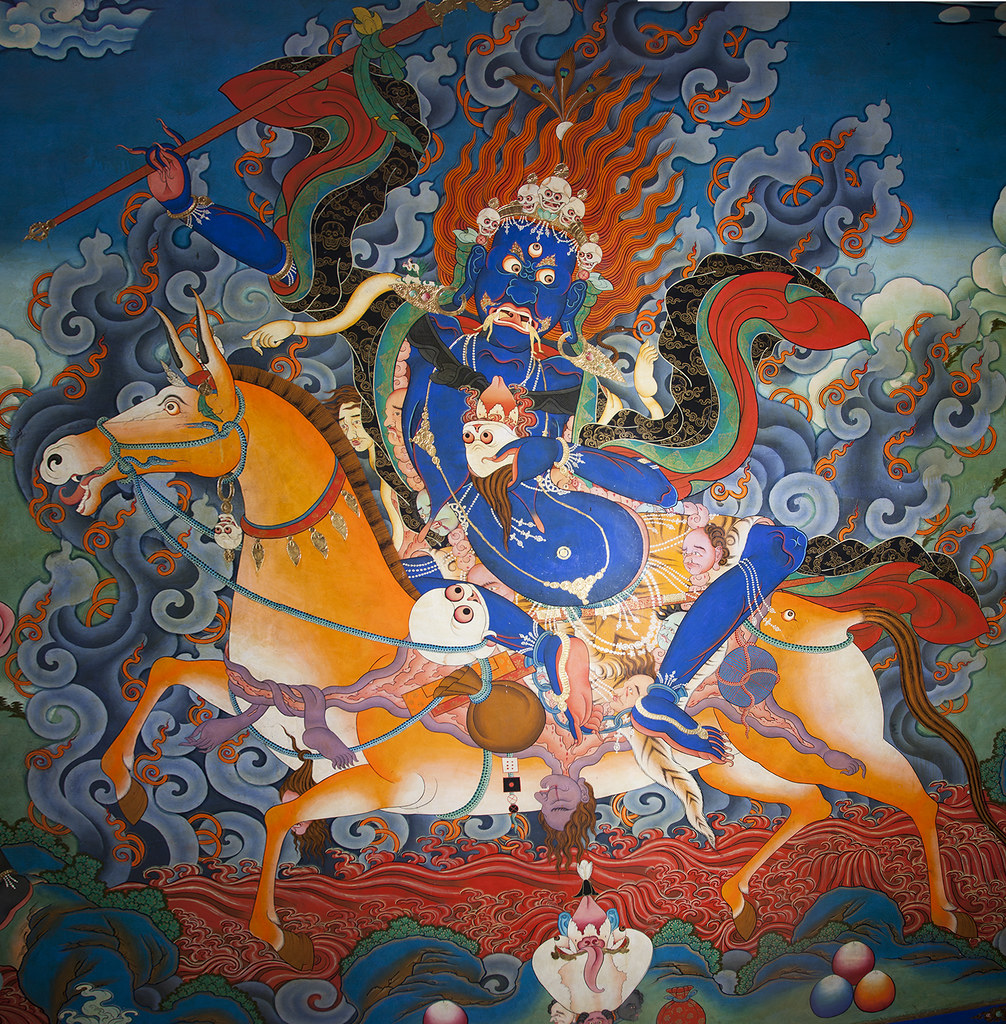
Palden Lhamo, Shri Devi (Sanskrit), is a protecting Dharmapala of the teachings of Gautama Buddha in the Gelug school of Tibetan Buddhism. She is also called Remati. She is the wrathful deity considered to be the principal Protectress of Tibet.

Palden Lhamo is the consort of Mahakala and has been described as "the tutelary deity of Tibet and its government", and as "celebrated all over Tibet and Mongolia, and the potent protector of the Dalai and Panchen Lamas and Lhasa."


She is said to reside in a lake within Tibet, called Lhamo Latso. The lake is charged with spiritual energy and is said to bestow visions of the future. One of the methods to search for a new incarnation of the Dalai Lama, the search party will meditate and propitiate Palden Lhamo by this lake.

I will live to be 110 years: Dalai Lama assures followers

Aug 28, 2019, | IANS

 
I will live to be 110 years: Dalai Lama assures followers

Dharamshala, Aug 27: Brushing aside concerns about his health, the Dalai Lama, 84, has assured his followers, especially Tibetans, that he is in the best of health and will live to be 110 years old. 

A video of his address to members of the Minnesota Tibetan Association at the Von Ngari Monastery on August 18 has been widely circulated on social media and was received with joy and relief by his followers around the world.

Concerns about his health were voiced following news that he had been admitted to a private hospital in Delhi due to a chest infection in April.

In his address, while consoling his followers, some of who could be heard weeping occasionally, the Dalai Lama recalled a dream in which the goddess of glory, one of the eight Dharma protectors and the protector deity of Tibet, Palden Lhamo riding on the back of the Dalai Lama proclaims that he will live for 110 years. 

The Dalai Lama also said that the other divinations carried similar foretelling, a statement from the Central Tibetan Administration said.

Holding a letter presented by the representative of Tibetans in Minnesota, the Dalai Lama reassured them again about his health while humorously remarking about the good functioning of his digestive tract. 

He also mentioned about the attention, support and best of medical services that were being provided to him by the Indian government.

Many among the six million Tibetans watched the video with tearful eyes and shared it with friends, parents, families, and colleagues.

"Tibetans have not forgotten me, and I will not forget you," said the Dalai Lama, as he patted one of the followers on the back while recounting a moment when thoughts of the Tibetan people flashed through his mind.


The Dalai Lama has lived in self-imposed exile in India since fleeing his homeland in 1959. 

I will live to be 110 years: Dalai Lama assures followers

Related image
 

Related image

Thursday, June 20, 2019

THE SANATANA DHARMA BOND BETWEEN INDIA AND TIBET

THE SANATANA DHARMA BOND BETWEEN INDIA AND TIBET
F7A7CE30-0225-4205-B8DC-80A06119DD19.jpg

From the beginning of human civilization, from the times of the origin of the Anatomically Modern Man in Tibet and India, the 'Sanatana Dharma' formulated the bond between the people of India and Tibet. These people participate in ritualistic worship of Mountains, and of bodies of Water such as the lakes and rivers which shape their earthly living experience. They seek the presence of the LORD God Creator in the acts of His Creation.

Rudranarasimham Rebbapragada
SPECIAL FRONTIER FORCE

6DAB670F-61A4-4517-83FC-0A5BBECAF392.jpg


First Group Of Kailash-Mansarovar Pilgrims For 2019 Yatra Reach Tibet

HOLY MOUNT KALASH & MANASAROVAR YATRA 2019

Kailash-Mansarovar Yatra: "All the members of the batch are safe. They were found medically fit by Indo-Tibetan Border Police or ITBP doctors during a check-up at Gunji.

All India | Press Trust of India | Updated: June 20, 2019, 13:52 IST

First Group Of Kailash-Mansarovar Pilgrims For 2019 Yatra Reach Tibet
Pilgrims on the Kailash-Mansarovar yatra have reached Tibet for darshan (File Photo)


Pithoragarh, Uttarakhand: 

The first batch of 58 Kailash-Mansarovar pilgrims reached Tibet today through the Lipulekh pass.
The pilgrims crossed over into Tibet through the Lipulekh pass located at 17,500 feet on way to Kailash-Mansarovar at 8:15 am, said Ashok Joshi, General Manager of Kumaon Mandal Vikas Nigam or KMVN, the nodal agency for the yatra.

"All the members of the batch are safe. They were found medically fit by Indo-Tibetan Border Police or ITBP doctors during a check-up at Gunji.

"The batch will return to the pass after spending seven days in Tibet where the pilgrims will have a darshan (view) of the holy Mount Kailash believed to be the abode of Lord Shiva. They will also take a dip in the sacred Mansarovar lake," Mr. Joshi said.

Besides the first batch, two other batches of pilgrims have also reached close to the Lipulekh pass, he added.
73A7BDB8-6ECD-44CE-BAF1-38B9A942D348.jpg


Friday, June 14, 2019

WHO IS THE DALAI LAMA? WHAT IS THE INSTITUTION OF THE DALAI LAMA?

WHERE IS TIBET? WHO IS THE DALAI LAMA?

Where is Tibet? Who is The Dalai Lama?
In my analysis, the Political Institution called ‘The Dalai Lama’ represents the Government of Tibet while the person called Tenzin Gyatso may have relinquished his power and may identify himself as the Retired Head of State of Tibet. While the exile Tibetan community elected a President of their choice, Tibetans presently living in Occupied Tibet do not participate in the activities of the Tibetan Government-in-Exile. Tibetans have not yet exercised their Right to Self-Rule or Self-Determination. As such, the Communist Party of China has no legal right to rule or govern Tibet. Military Occupation and Colonization of Tibet cannot abolish The Institution of The Dalai Lama known as The Ganden Phodrang.
Rudranarasimham Rebbapragada
SPECIAL FRONTIER FORCE
Where is Tibet? Who is The Dalai Lama?

Enigma of the Dalai Lama

The writer is former Ambassador of Pakistan and ex-Assistant Secretary General of OIC
Latest news, courtesy AFP, has it that the US Ambassador to China has called on Beijing to open a ‘substantive dialogue with the Dalai Lama’. He made these remarks during a visit to northwest China’s Qinghai province. 

This bit of news gives rise to several questions. For one thing, it is something of a pity that, despite having won the Nobel Prize for Peace, the Dalai Lama has hardly been an agitator on the side of peace. Instead, he has often appeared as a tool in the hands of political forces that have an axe to grind against the Peoples’ Republic of China.
One has nothing against the Dalai Lama. He is undoubtedly a very revered personality. He may also be a ‘symbol of peace’ in the estimation of the US administration. But then he has also allowed himself to become a highly controversial political personality and one who has no qualms about being manipulated by certain powers to further their own agendas on the chessboard of international intrigue.
The Dalai Lama went into exile in the 1950s when China asserted its sovereignty over Tibet. He has squandered away several valuable opportunities of coming to terms with the reality of Tibet that has been accepted legally as a part of China by most of the world. This is not the occasion to go into the political complexities of this question. What is important is that the Dalai Lama could perhaps have done greater service to his cause, and to that of peace, if he had adopted the path of reconciliation rather than allow his followers to be kept hostage in a game of high stakes on the international chessboard. It should be more in the character of a revered religious personality and Nobel Peace laureate to work for a denouement leading to a grand reconciliation rather than confrontation.
Be that as it may, it came as something of a disappointment to the well-wishers of the Dalai Lama and his followers to find that he had opted to become a pawn in the US campaign aimed at the ‘containment of China’. Years back, President Bush had presented Tibet’s ‘exiled’ spiritual leader with the US Congress’ highest civilian award and taken advantage of the occasion to offer some gratuitous advice to the Chinese leadership, which the latter understandably had taken exception to.
There was a widespread feeling that the timing of the US Congress award to the Dalai Lama was somewhat inappropriate. The only context that this award fitted into was the US obsession with ‘containment’ of China. In this campaign, the Dalai Lama appeared to have allowed his image to be used as a (willing) pawn. Knowing and acknowledging his stature as a religious personality, this can be termed as something of a pity.
The one inference that can be drawn from the latest US statement is that the American administration under President Trump may have the intention to up the ante and revisit the erstwhile forward policy of former president Bush aimed at ‘containment of China’.
It must be recognized that due to its pragmatic and realistic policies, China has meanwhile earned for itself a respected place under the sun. Due to its conscious decision to eschew unnecessary confrontational policies in favor of concentration on a constructive drive veered towards economic development, China has become a major economic prime-mover.
It is a matter of some interest that India appears as an inevitable variable in all the regional equations that concern China. India is host to the Dalai Lama and also the co-signatory of the India-US nuclear deal of doubtful credentials. India, of course, is second to none in its ability to manipulate the twists and turns related to the moves on the international chessboard. In aligning itself with the sole superpower in a China-baiting exercise, it surely must have a very good idea which side its bread is buttered on. No one should have any uncalled-for illusions, though. It would hardly be advisable to underestimate China at this point in time.
Published in The Express Tribune, June 10th, 2019.
Where is Tibet? Who is The Dalai Lama?


Monday, April 29, 2019

PRAYER FLAGS OF GYIRONG COUNTY, TIBET

PRAYER FLAGS OF GYIRONG COUNTY, TIBET
I recognize the identity of Tibet by simply viewing the Prayer Flags that adorn this Land.
Rudranarasimham Rebbapragada
Special Frontier Force
Prayer Flags of Gyirong County, Tibet.
Photo taken on April 28, 2019, shows the scenery in Gyirong County of Xigaze Region, Tibet. (Photo: Xinhua)
Prayer Flags of Gyirong County, Tibet.
Photo taken on April 28, 2019, shows a woman working at Naicun Village in Gyirong County of Xigaze Region, Tibet. (Xinhua/Jigme Dorje)
Villagers walk in Gyirong County of Xigaze Region, Tibet, April 28, 2019. (Photo: Xinhua)
Prayer Flags of Gyirong County, Tibet.
Photo taken on April 28, 2019, shows a yak resting at Gyironggou in Gyirong County of Xigaze Region, Tibet. (Xinhua/Jigme Dorje)
Prayer Flags of Gyirong County, Tibet.
Photo taken on April 28, 2019, shows the scenery in Gyirong County of Xigaze Region, Tibet. (Xinhua/Jigme Dorje)
Prayer Flags of Gyirong County, Tibet.
Photo taken on April 28, 2019, shows plants in Gyirong County of Xigaze Region, Tibet. (Xinhua/Jigme Dorje)
Prayer Flags of Gyirong County, Tibet.
Photo taken on April 28, 2019, shows the scenery in Gyirong County of Xigaze Region, Tibet. (Photo: Xinhua)
Prayer Flags of Gyirong County, Tibet.


Friday, April 26, 2019

THE SUPREME RULER OF TIBET RETURNS TO HIS BASE


THE SUPREME RULER OF TIBET RETURNS TO HIS BASE

The Supreme Ruler of Tibet returns to his base after treatment in a hospital for a chest infection.

Rudranarasimham Rebbapragada
SPECIAL FRONTIER FORCE

DALAI LAMA BACK HOME AFTER TREATMENT IN A HOSPITAL
Clipped from: https://home.bt.com/news/world-news/dalai-lama-back-home-after-treatment-in-hospital-for-chest-infection-11364357764794
Hundreds welcomed him home as he described the ailment as 'a little bit serious'.

The Dalai Lama has returned to his headquarters in the north Indian hill town of Dharmsala after a brief stay in a hospital in the capital for treatment of a chest infection.
Hundreds of exiled Tibetans lined the streets of Dharamsala carrying ceremonial scarves and incense sticks to welcome the Dalai Lama on Friday.
The 83-year-old Tibetan spiritual leader told reporters that he had fully recovered, but that the illness had been "a little bit serious".

The Dalai Lama described the illness as 'a little bit serious' (Chris Radburn/PA)
He did not give any details.
The Dalai Lama usually spends several months a year traveling the world to teach Buddhism and highlight Tibetans' struggle for greater freedom in China.

But he has cut down on his travels in the past year to take care of his health.

Sunday, March 31, 2019

THE GREAT PROBLEM OF TIBET IS ON THE BACK BURNER

THE GREAT PROBLEM OF TIBET IS ON THE BACK BURNER

on the back burner
The Great Problem of Tibet is on the Back Burner.
As the month of March, Tibet Awareness Month is heading towards its end, I regret to report that The Great Problem of Tibet is still on the Back Burner. But I am adamantly hopeful for the word 'EVIL' means Doom, Apocalypse, Calamity, Cataclysm, and Disaster. The global attention for Tibet has shrunk but the Evil Red Empire could be rushing ahead to meet its unavoidable Fate.

Rudranarasimham Rebbapragada
Special Frontier Force
You felt secure in your wickedness, you said, "No one sees men; your wisdom and your knowledge led you astray, and you said in your heart, "l am, and there is no one besides me.» But evil shall come upon you, which you will not know how to charm away; disaster shall fall upon you, for which you will not be able to atone; and ruin shall come upon you suddenly, of which you know nothing. Isaiah 47:10 & 11
The Great Problem of Tibet is on the Back Burner. 

How China has shrunk global attention for Tibet and the Dalai Lama — Quartz

Clipped from: https://qz.com/1565178/how-china-has-shrunk-global-attention-for-tibet-and-the-dalai-lama/
EFEBAAC0-9A3C-447A-8FBB-9CA8BFF659DB.jpg
The Great Problem of Tibet is on the Back Burner.
March is a sensitive month in Tibet. In 1959, an uprising led to a bloody crackdown by Chinese forces, culminating in the 23-year-old Dalai Lama’s escape to India on March 17, where he arrived after two weeks of apprehension over his fate. Protests marking the Tibetan revolt were put down in 1989, and most recently in 2008, months before China was set to showcase itself to the world with the opening of the Beijing Olympics.
It’s hard to imagine such acts of defiance taking place today. In 2011, Beijing further tightened its chokehold on the autonomous region under the leadership of new Tibet Communist Party secretary Chen Quanguo (paywall), who implemented a vast array of security measures, including the incarceration and “re-education” of those who had returned from listening to the Dalai Lama’s teachings in India. Tibetans were also forced to adapt their culture to party ideology and to learn how to “revere” science, part of Beijing’s ongoing propaganda campaign that portrays its rule in Tibet as a benevolent exercise in modernization and anti-feudalism. Ten years ago today (March 28), the Chinese instituted Serfs’ Emancipation Day as a holiday to celebrate its program.
2DCB58B2-448A-4793-9F0C-E94D6281CEBE.jpg
The Great Problem of Tibet is on the Back Burner.

Reuters: Smoke rises from burning buildings below the Potala Palace in the Tibetan capital Lhasa during protests on March 14, 2008.
“To some extent, China has been very successful in dealing with Tibet,” said Tsering Shakya, an academic at the University of British Columbia in Vancouver.
Beijing is applying the Tibet model to another minority considered to pose a danger to the state. In 2016, Chen became party secretary in the Xinjiang region of northwest China, where his Tibetan policies are largely seen as the foundation for repression of the Uyghur minority. Large-scale re-education camps hold hundreds of thousands of Muslims as Uyghur cultural and religious practices face systematic erosion.

From Kundun to Rock Dog

Advocates hope that growing international awareness over Xinjiang will help rekindle the world’s attention toward Tibet, which has dwindled amid the Chinese Communist Party’s relentless efforts to reshape the global conversation about the region.
Perhaps the starkest manifestation of that is in the arts. Tibet, once a cause célèbre in Hollywood as the subject of films such as Kundun and Seven Years in Tibet—in which Brad Pitt played the role of an Austrian mountaineer who tutored the young Dalai Lama—is today almost nowhere to be seen on screen. Actor Richard Gere, one of the most well-known celebrities to support Tibetan independence, said in 2017 that he has been shut out of major productions because of his outspokenness.
B7927B86-18F7-4A32-84DA-AC6699F99DC2.jpg
The Great Problem of Tibet is on the Back Burner.
Reuters/Yuri Gripas
Nancy Pelosi talks to Richard Gere at a memorial event for Kasur Gyari, former special envoy of the Dalai Lama to the US, March 12, 2019.
When Tibet is still visible, said Seagh Kehoe at the University of Leicester, it is often in a watered-down and totally depoliticized fashion, as in the animated Rock Dog, a 2016 joint US-China production about a Tibetan mastiff who becomes a music star. Self-censorship over Tibet can be seen at work in London as well, with a West End theater suspending performance of a play about Tibet last year reportedly at the urging of the British Council, the UK’s international cultural organization, which is partly government funded. Following accusations of censorship by its playwright and apologies by the theater, Pah-la is now due to be staged next month.
 

Shaping the narrative on campus

Universities are another important battleground in Beijing’s attempt to mold its narrative. Campus activism in an earlier era was generally pro-Tibetan. That’s changing today with the ballooning number of Chinese students abroad—over 600,000 now compared with fewer than 50,000 in the late 1990s.
Chinese authorities “see overseas students as allies in their ongoing efforts to counter regime opponents” including groups sympathetic to Tibet, Xinjiang, Taiwan, and the Falun Gong, according to a report (pdf) last year by the Wilson Center, a Washington, DC-based think tank. The report detailed attempts by Chinese officials to put pressure on institutions to cancel invitations to the Dalai Lama and to bring more Chinese delegations to US universities to espouse the Communist Party’s line on Tibet.
Chemi Lhamo, a Tibetan student who was elected last month as a student president at the University of Toronto, received thousands of threatening Instagram messages from Chinese students. The student union decided to close her office out of concern for her safety. Chinese officials in Canada denied having anything to do with the incident or a case in which an Uyghur speaker was disrupted by Chinese students at McMaster University who had reportedly sought advice (paywall) from the consulate in Toronto. Chinese diplomats in Canada have praised the actions of students in both instances as being “patriotic.”

“Slow violence” gets less attention

Draconian restrictions on travel by Tibetans, foreign diplomats and journalists have made getting disseminating information from the region immensely more difficult.
Ever-tightening security has eliminated visible, large-scale displays of protest. The “optics of urgency” spotlighting the Xinjiang situation, such as satellite photos of camps and reporting by journalists on the ground, are missing from the Tibet narrative, wrote Gerald Roche, an anthropologist at La Trobe University in Melbourne. The “slow violence” that characterizes the plight of Tibet today, Roche added, makes it harder to get global attention.
Ahead of the 60th anniversary of the uprisings in Tibet, Chinese authorities further tightened control, restricting even foreign tourists from traveling there. Meanwhile, a white paper from China’s State Council on Tibet released yesterday (March 27) boasted of “democratic reform” over the past six decades, including a chapter titled “The People Have Become Masters of Their Own Affairs.”
9CEB00E0-1CE5-4802-B0A3-21BBA22CAA1E.jpg
The Great Problem of Tibet is on the Back Burner.
Reuters/Thomas Peter
Armed police attempt to prevent a photographer from taking pictures at the entrance to the village of Taktser, known in Chinese as Hongya, where the Dalai Lama was born in 1935, Qinghai province, China March 9, 2019.
Dramatic protests have continued. Since 2009, Tibetans have been self-immolating as a form of protest, with the act spreading from nuns and monks to laypeople. The International Campaign for Tibet’s latest count of self-immolations totals 155, with the last of the three known to have occurred in 2018 taking place in December. International media coverage, however, has largely disappeared. “We have some 150 cases of self-immolation, but for all, I know it could be 300,” said Kevin Carrico at Monash University in Australia. “Even for people who pay attention to this situation, we don’t really know what’s happening.”

The debate over the next Dalai Lama 

Sophie Richardson, China director at Human Rights Watch in Washington, said that spotlighting China’s human-rights abuses in Xinjiang can reinforce mutual support between diaspora Uyghur and Tibetan groups. There’s a common “core pathology” underlining Beijing’s actions in both places, including the “erasing of cultural identities and practices,” she said. Lhamo, the Tibetan student, told Quartz that a growing focus of her activism now involves building ties and sharing information with Uyghurs, Taiwanese, and the Falun Gong.
Advocacy groups have also welcomed renewed pressure by the US on Beijing. Congress passed the Tibet Reciprocal Act in December, which denies entry to the US any Chinese official who blocks Americans from going to Tibet. Matteo Mecacci, a former lawmaker in Italy and president for the International Campaign for Tibet, said the bill signals “enduring, bipartisan support for Tibet” in the US. The law requires annual reports detailing access to Tibet for Americans, with the first published this week.
•P
The Great Problem of Tibet is on the Back Burner.
AP Photo/Ashwini Bhatia
The Dalai Lama smiles as he sits on his chair at the Tsuglakhang temple in Dharmsala, India, Feb. 27, 2019.
The fight over the Dalai Lama’s succession—and China’s obsessive control over it—could also return Tibet to headlines in the coming years.
Amid a flurry of attention this month marking the leader’s 60th anniversary in exile in Dharamsala, the 83-year-old Dalai Lama said in an interview that his next incarnation could be found in India, adding that Beijing is likely to appoint its own successor whom “nobody will trust.” Beijing, which consistently maintains that the Dalai Lama is a separatist, promptly reiterated that the selection of the next Tibetan spiritual leader must follow Chinese law.
e Back B nér
The Great Problem of Tibet is on the Back Burner.


Monday, March 25, 2019

THE BATTLE FOR TIBET. TRUTH vs GUN

The Battle for Tibet. Truth vs Gun.

“Our strength, our power is based on truth. Chinese power based on the gun,” the Dalai Lama said. “So for short term, the gun is much more decisive, but long term truth is more powerful.”


In my analysis, the Battle for Tibet will not be decided by either Chinese Gun or American Gun. The truth will prevail. China will reap the consequences of her own Evil actions. Tibet's Identity is shaped by Natural Forces, Natural Causes, and Natural Factors that condition the nature of Tibetan Existence. Nature will unleash a physical force to compel China to withdraw from illegally occupied Tibetan Territory.

Rudranarasimham Rebbapragada
Special Frontier Force

The Battle for Tibet. Truth vs Gun.

Exclusive: Dalai Lama contemplates Chinese gambit after his death. Reuters


Clipped from: https://www.reuters.com/article/us-china-tibet-dalai-lama-exclusive/exclusive-dalai-lama-contemplates-chinese-gambit-after-his-death-idUSKCN1QZ1NS?feedType=RSS&feedName=topNews

DHARAMSHALA, India (Reuters) -


The Dalai Lama, the spiritual leader of Tibetan Buddhism, said on Monday it was possible that once he dies his incarnation could be found in India, where he has lived in exile for 60 years, and warned that any other successor named by China would not be respected.

Sat in an office next to a temple ringed by green hills and snow-capped mountains, the 14th Dalai Lama spoke to Reuters a day after Tibetans in the northern Indian town of Dharamshala marked the anniversary of his escape from the Tibetan capital, Lhasa, disguised as a soldier.

He fled to India in early 1959 after a failed uprising against Chinese rule and has since worked to draw global support for linguistic and cultural autonomy in his remote and mountainous homeland.

China, which took control of Tibet in 1950, brands the 83-year-old Nobel peace laureate a dangerous separatist.

Pondering what might happen after his death, the Dalai Lama anticipated some attempt by Beijing to foist a successor on Tibetan Buddhists.

“China considers Dalai Lama’s reincarnation as something very important. They have more concern about the next Dalai Lama than me,” said the Dalai Lama, swathed in his traditional red robes and yellow scarf.

“In future, in case you see two Dalai Lamas come, one from here, in a free country, one chosen by Chinese, then nobody will trust, nobody will respect (the one chosen by China). So that’s an additional problem for the Chinese! It’s possible, it can happen,” he added, laughing.

China has said its leaders have the right to approve the Dalai Lama’s successor, as a legacy inherited from China’s emperors.

But many Tibetans - whose tradition holds that the soul of a senior Buddhist monk is reincarnated in the body of a child on his death - suspect any Chinese role as a ploy to exert influence on the community.

Born in 1935, the current Dalai Lama was identified as the reincarnation of his predecessor when he was two years old.

Speaking in Beijing at a daily news briefing on Tuesday, Chinese foreign ministry spokesman Geng Shuang said the 14th Dalai Lama himself was chosen by following centuries-old religious rituals and history, which were “respected and protected” in rules and ordinances regulating religion.
“Therefore reincarnations, including that of the Dalai Lama, should observe the country’s laws and regulations and follow the rituals and history of religion,” Geng said.

UP FOR DISCUSSION

Many of China’s more than 6 million Tibetans still venerate the Dalai Lama despite government prohibitions on displays of his picture or any public display of devotion.

The Dalai Lama said contact between Tibetans living in their homeland and in exile was increasing, but that no formal meetings have happened between Chinese and his officials since 2010.

Informally, however, some retired Chinese officials and businessman with connections to Beijing do visit him from time to time, he added.

He said the role of the Dalai Lama after his death, including whether to keep it, could be discussed during a meeting of Tibetan Buddhists in India later this year.

He, however, added that though there was no reincarnation of Buddha, his teachings have remained.

“If the majority of (Tibetan people) really want to keep this institution, then this institution will remain,” he said. “Then comes the question of the reincarnation of the 15th Dalai Lama.”


FILE PHOTO: Tibetan spiritual leader the Dalai Lama, Patron of Children in Crossfire, speaks during a press conference in Londonderry, Northern Ireland September 11, 2017. REUTERS/Clodagh Kilcoyne/File Photo

If there is one, he would still have “ no political responsibility”, said the Dalai Lama, who gave up his political duties in 2001, developing a democratic system for the up to 100,000 Tibetans living in India.

SEMINAR IN CHINA?

During the interview, the Dalai Lama spoke passionately about his love for cosmology, neurobiology, quantum physics and psychology.

If he was ever allowed to visit his homeland, he said he’d like to speak about those subjects in a Chinese university.

But he wasn’t expecting to go while China remained under Communist rule.

“China - great nation, ancient nation - but its political system is a totalitarian system, no freedom. So, therefore, I prefer to remain here, in this country.”

The Dalai Lama was born to a family of farmers in Taktser, a village on the northeastern edge of the Tibetan plateau, in China’s Qinghai province.

During a recent Reuters visit to Taktser, police armed with automatic weapons blocked the road. Police and more than a dozen plain-clothed officials said the village was not open to non-locals.

“Our strength, our power is based on truth. Chinese power based on the gun,” the Dalai Lama said. “So for short term, the gun is much more decisive, but long term truth is more powerful.”

Reporting by Krishna N. Das; Additional reporting by Philip Wen in BEIJING; Editing by Simon Cameron-Moore

The Battle for Tibet. Truth vs Gun.