Tuesday, September 8, 2020

A Tibetan's Sacrifice for Freedom is known to all of India for the first time since 1962


This is the first time a Tibetan Sacrifice is known to all of India

For the very first time since its inception, a fallen soldier of Special Frontier Force gets a public funeral

For the very first time since its inception, a fallen soldier of Special Frontier Force gets a public funeral.

For the very first time since its inception, a fallen soldier of Special Frontier Force gets a public funeral.

I have been demanding for a long time to give public recognition to the fallen soldiers of Special Frontier Force. Finally, on September 07, 2020, Company Leader Nyima Tenzin of Special Frontier Force has departed from us with due public honor. This is the first time a Tibetan’s sacrifice is known to all of India.

Rudra Narasimham Rebbapragada

Special Frontier Force-Establishment No. 22-Vikas Regiment

MONDAY, MAY 25, 2020 – THE UNKNOWN SOLDIER OF AMERICA PAYS TRIBUTE TO THE UNMOURNED FREEDOM FIGHTERS OF SPECIAL FRONTIER FORCE


India’s Special frontier force’s Tibetan soldier Nyima Tenzin cremated with full public honor

This is the first time a Tibetan’s sacrifice is known to all of India. Army officials pay tribute to Special Frontier Force (SFF) commando Nyima Tenzin during a wreath-laying ceremony in Devachan, Leh.(PTI)

This is the first time a Tibetan’s sacrifice is known to all of India. Army officials pay tribute to Special Frontier Force (SFF) commando Nyima Tenzin during a wreath-laying ceremony in Devachan, Leh.(PTI)

With his body wrapped in Indian and Tibetan flags, Tenzin was cremated as the atmosphere reverberated with slogans like “Bharat Mata Ki Jai”, “We salute Indian army”. The Indian National anthem was also sung along with and the anthem of Tibetan Government in Exile which is considered as the Tibetan National Anthem written in 1950.  

Senior Bharatiya Janata Party (BJP) leader Ram Madhav’s presence at the official funeral of a Tibetan soldier from the secretive Special Frontier Force (SFF) on Monday created a flutter in diplomatic and political circles amid the border standoff with China.

The funeral of SFF Company Leader Nyima Tenzin, killed in a landmine blast in an operation along the Line of Actual Control (LAC) during August 29-30, was held at Leh in the union territory of Ladakh. The funeral cortege was joined by scores of cars and motorcycles and people waving the Indian and Tibetan flags.

Tenzin’s coffin, carried in an army truck, was draped in the Indian tricolor and Tibetan flag, which were handed over to his widow at the funeral. Experts noted this was probably the first time an SFF personnel who died in action was given a public funeral, complete with military honors and a volley of shots by a ceremonial guard.

Following the protocol for those killed in action, Indian Army troops folded the two flags and handed them over to Tenzin’s wife. Tenzin had 33 years of service in the SFF. He leaves behind his wife and three children. This is the first time a Tibetan’s sacrifice is known to all of India. Tenzin Yangkey, a student, said that they came to the funeral to pay tributes to a man who sacrificed his life for India. “We are all proud of him,” Yangkey said.

During the operation, another junior soldier Tenzin Loden, 24, was critically injured in the same explosion, and is currently undergoing treatment at the military hospital in Ladakh. The injured Tenzin Loden is from the same settlement.

BJP national general secretary Madhav posted photos of the funeral and paid tribute to Tenzin on Twitter but subsequently deleted the tweet. Screenshots of his tweet, which were widely shared, showed he had posted: “Attended [the] funeral of SFF Coy Ldr Nyima Tenzin, a Tibetan who laid down his life protecting our borders in Ladakh, and laid a wreath as a tribute. Let [the] sacrifices of such valiant soldiers bring peace along the Indo-Tibetan border. That will be [the] real tribute to all martyrs.”

People present at the funeral shouted slogans such as “Bharat Mata ki jai”, “Tibet desh ki jai”, “Vikas Regiment zindabad” and “We salute Tenzin”. SFF is also known as Establishment 22 and Vikas Regiment. Banners put up at the funeral site by SFF ex-servicemen described Tenzin as a soldier who “sacrificed his life to protect his second homeland India fighting common enemy China”.

Madhav spoke to the media at the funeral, saying in Hindi that he hoped Tenzin’s sacrifice “will bring peace to the border” and that “efforts are on to end the tension”. He added, “We hope peace will be restored soon.”

People familiar with developments said Madhav hadn’t attended the funeral as a representative of the government. On Sunday, Madhav began a two-day visit to Ladakh, a union territory that was carved out of the erstwhile state of Jammu and Kashmir, whose special status was scrapped in August 2019.

However, the move marks a shift from the government’s reported decision in early 2018 asking officials and leaders to skip events which were being organised at the time to mark the Dalai Lama’s 60 years in exile. As the government worked to improve ties with China, especially through the mechanism of informal summits, the Tibet issue was largely sidelined.

SFF was raised with former Tibetan guerrillas in 1962 and went on to see action during the 1971 war with Pakistan that led to the creation of Bangladesh and the 1999 Kargil conflict. It is led by army officers and most of its personnel are men of Tibetan origin.

Amitabh Mathur, a former special secretary in the Research and Analysis Wing (RAW) who advised the government on issues related to Tibet, said it made sense for India to use a force such as SFF in the current scenario because of the special skills of its personnel. “They are used to operating at high altitudes and it would be an enormous waste if they are kept away from the terrain where they are most useful,” he said.

However, he said the Indian side will have to ensure that their use is followed up with other messages that reach the overall Tibetan community and a consistent policy. “There has to be some sort of gesture, an overt sign and this message should reach the Tibetans in Tibet,” he added.

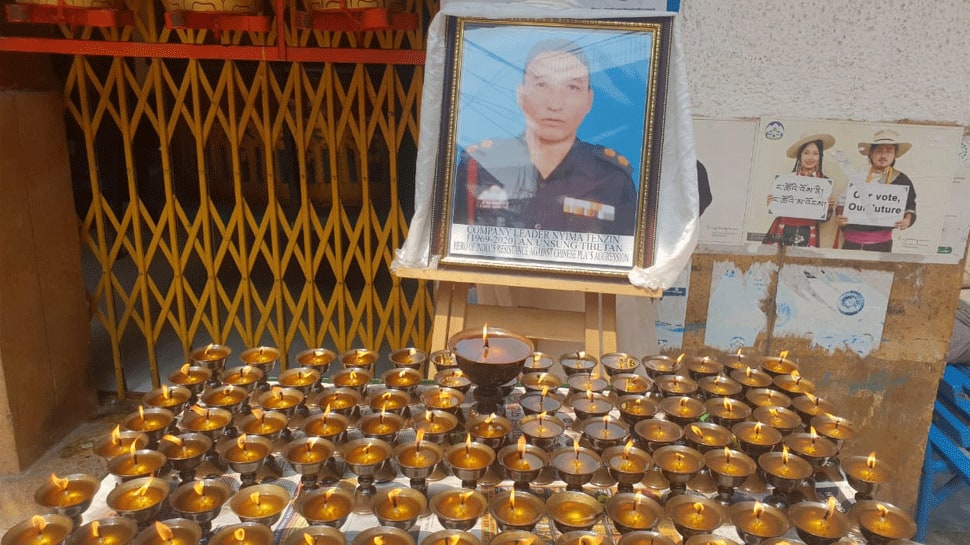
This is the first time a Tibetan’s sacrifice is known to all of India.

This is the first time a Tibetan’s sacrifice is known to all of India.

This is the first time a Tibetan’s sacrifice is known to all of India. Indian soldiers pay their respects during the funeral of their comrade, Tibetan-origin India’s special forces soldier Nyima Tenzin in Leh on September 7, 2020. (Mohd Arhaan Archer/AFP/Getty Images)

This is the first time a Tibetan’s sacrifice is known to all of India. Indian soldiers pay their respects during the funeral of their comrade, Tibetan-origin India’s special forces soldier Nyima Tenzin in Leh on September 7, 2020. (Mohd Arhaan Archer/AFP/Getty Images)


Sunday, September 6, 2020

Special Frontier Force-Establishment No.22-Vikas Regiment thwarts the Chinese incursion in Ladakh, Kashmir, India

Special Frontier Force-Establishment No. 22-Vikas Regiment thwarts Chinese incursion in Ladakh, Kashmir, India

India thwarts another Chinese incursion in Ladakh

DECCAN CHRONICLE | PAWAN BALI Published Sep 1, 2020.  

Pre-emptive move by Indian Army to secure another LAC position signals its intent to dig in for the winter.

Special Frontier Force thwarts Chinese incursion in Ladakh, Kashmir, India

The Pangong Tso lake in Ladakh on the banks of which India and China have been engaged in a standoff for four months. India claimed on Monday that it pre-empted a move by the Chinese army to occupy Indian territory at a new point in the region. (AP file photo)

New Delhi: The Indian army said on Monday that it "pre-empted" an attempt by Chinese troops to transgress and grab land on the southern banks of Pangong Tso on the intervening night of 29-30 August 2020.

This was an attempt by the Chinese to open a new front in the Ladakh sector. India and China were until now in a standoff  in the "Finger area" on the northern banks of the Pangong Tso. But now they are also looking to infiltrate in the Chushul sector.

In a statement issued on Monday, the Indian Army said PLA troops carried out provocative military movements to change the status quo on the night of 29-30 August 2020. “Indian troops pre-empted this PLA activity on the Southern Bank of Pangong Tso Lake, undertook measures to strengthen our positions and thwart Chinese intentions to unilaterally change facts on the ground,” it said.

The statement added that the Indian Army is committed to maintaining peace and tranquility through dialogue, but is also equally determined to protect India's territorial integrity.

A brigade commander level flag meeting was held at Chushul to resolve the issue.

As per initial reports, the Army had received information that the Chinese started building up forces to occupy Indian territory on the southern banks of Pangong Tso. The Indian Army physically occupied the area as soon as the PLA tried its transgression. There was no physical clash between the troops.

The Indian Army's “pre-emptive” move comes days after the Chief of Defense staff (CDS) Gen. Bipin Rawat warned that India has "military options" to deal with Chinese transgression in Ladakh if talks between the countries at the military and diplomatic level don't yield any result.

The Chinese army’s Western Theater Command accused India of crossing the Line of Actual Control and deliberately launching provocations. “China strongly opposes the acts and urges India to immediately withdraw the troops that have illegally crossed the LAC,” it said.

It said that Chinese troops are taking necessary measures in response to Indian troops provocations and will closely follow the situation and resolutely safeguard national sovereignty, peace and stability at the border area.

The military standoff between India and China in Ladakh will complete four months this week. The two armies are involved in a standoff in Pangong Tso, Hot Springs area and Despang-DBO sector in Ladakh.

A series of military and diplomatic talks between India and China have failed to persuade China to disengage. Instead China has used this time of negotiations with India to bring in more forces at the LAC, position heavy weaponry, construct helipads, build air defense systems, and deploy missiles at new positions.

It has even deployed its most advanced fighter jets J-20 at Hotan airbase which is 200 miles from Ladakh and they are carrying out sorties directly threatening India. China is also reportedly laying down optic fiber at LAC to further consolidate its transgressions.    

In the Northern Bank of Pangong Tso, China has illegally occupied 8 km of Indian territory between finger 4 and 8. Despite a series of diplomatic and military dialogues China has refused to vacate the area between finger 5 and 8 which it had illegally occupied in May 2020. China has built up bunkers, gun positions and brought heavy artillery in the finger area.     

The Chinese attempt to occupy new areas comes despite a series of engagements at the diplomatic and military level to disengage and deescalate the situation in the Ladakh sector.  The latest confrontation means that the situation is unlikely to deescalate any time soon and will continue in the winter too. India has already started preparations for winter and is stocking up supplies required for thousands of new troops deployed in the area.  

Special Frontier Force thwarts Chinese incursion in Ladakh, Kashmir, India. The 1962 India-China War Memorial at Chushul, Ladakh.

Special Frontier Force personnel were used  by Indian Army to occupy these strategic peaks in the Southern banks of Pangong Tso. This took the Chinese army by surprise. The occupation of these heights has shown Indian resolve to take the fight to the Chinese side. 

Chushul, Ladakh, the 1962 India-China War Memorial.


Monday, August 10, 2020

Sunday, July 5, 2020

Abhimanamennadu Galgu Rama - Begada -- Patnam Subramanya Iyer_TNS


I cry out to my LORD to uphold my dignity and self-esteem. But, I love to cry out in my own mother tongue.

Wednesday, June 17, 2020

The Seventy Year Misery of Military Occupation of Tibet Must End Now

The United States Must Evict the Military Occupier of Tibet-The Unfinished Korea-Vietnam War The United States Must Evict the Military Occupier of Tibet-The Unfinished Korea-Vietnam War. In my analysis, ‘The Cold War in Asia’ represents the dangers of the spread of Communism to the mainland China. The United States armed intervention in the Korean Peninsula did not prevent the Communist takeover of Tibet in 1950. The United States must recognize the real Enemy and must evict the Military Occupier of Tibet to secure Peace, Freedom, Democracy, and Justice in South Asia. Rudra Narasimham Rebbapragada Special Frontier Force-Establishment No. 22-Vikas Regiment The United States Must Evict the Military Occupier of Tibet. Special Frontier Force VS The Evil Red Empire-Red China . India-China clash: Diplomats ‘strongly protest’ over border clashes BBC June 17, 2020, 2:52 PM UTC The two nations have an agreement that says no guns should be taken within two kilometres of the border The United States Must Evict the Military Occupier of Tibet. India and China have an agreement that says no guns should be taken within two kilometres of the border. The Indian and Chinese foreign ministers have exchanged protests over clashes in a disputed Himalayan border area which led to the deaths of at least 20 Indian troops. India’s Subrahmanyam Jaishankar said China tried to erect a structure inside Indian territory, while China’s Wang Yi said Indian troops attacked first. But in a phone call both men promised not to escalate the situation. It was the first deadly clash at the disputed border for at least 45 years. Soldiers reportedly brawled with sticks and bats but no shots were fired. China has not released casualty figures. Unconfirmed reports in Indian media say at least 40 Chinese soldiers died. Some Indian soldiers are still believed to be missing. Earlier Indian Prime Minister Narendra Modi said the Indian deaths “will not be in vain” and that India would be “proud that our soldiers died fighting the Chinese” in the clash in the Ladakh region on Monday. Addressing the confrontation for the first time in a televised address on Wednesday, he said: “India wants peace but when provoked, India is capable of giving a fitting reply, be it any kind of situation.” What did the two diplomats say? An Indian government statement following the phone conversation said that Chinese troops had tried to put up a structure on the Indian side of the de facto border, the Line of Actual Control (LAC), in the strategically important Galwan Valley. It described this as “premeditated and planned action that was directly responsible for the resulting violence and casualties” and urged China to “take corrective steps”. Google Maps view of Galwan Valley The United States Must Evict the Military Occupier of Tibet. Google Maps view of Galwan Valley The statement concluded that neither side would take action to escalate matters. Meanwhile a Chinese statement quoted Mr Wang as saying: “China again expresses strong protest to India and demands the Indian side launches a thorough investigation… and stop all provocative actions to ensure the same things do not happen again.” “Both sides should resolve the dispute through dialogue, and keep the border safe and tranquil,” he added. What happened? The fighting occurred in the precipitous, rocky terrain of the Galwan Valley. Indian media say soldiers engaged in direct hand-to-hand combat, with some “beaten to death”. During the fight, one newspaper reported, others fell or were pushed into a river. A satellite image of Galwan Valley shows the rocky and barren terrain The United States Must Evict the Military Occupier of Tibet. A satellite image of Galwan Valley shows the rocky and barren terrain. The Indian army initially said a colonel and two soldiers had died. It later said that “17 Indian troops who were critically injured in the line of duty” had died from their injuries, taking the “total that were killed in action to 20”. “I understand that some [further] Indian soldiers went missing. The Indian side is still working to release them from Chinese custody,” defence analyst Ajai Shukla told the BBC. Indian forces appear to have been massively outnumbered by Chinese troops. A senior Indian military official told the BBC there were 55 Indians versus 300 Chinese, who he described as “the Death Squad”. “They hit our boys on the head with metal batons wrapped in barbed wire. Our boys fought with bare hands,” the officer, who did not want to be named, said. The clash has provoked protests in India, with people burning Chinese flags. China has not confirmed how many of its personnel died or were injured. The BBC’s Robin Brant in Beijing says that China has never given contemporaneous confirmation on military deaths outside of peacekeeping duties. Our correspondent adds that on this occasion China’s propagandists may not want to fan nationalist flames at home by making much of any loss, or admit to a significant and demoralizing loss. This is not the first time the two nuclear-armed neighbors have fought without conventional firearms on the border. India and China have a history of face-offs and overlapping territorial claims along the more than 3,440km (2,100 mile), poorly drawn LAC separating the two sides. India shows restraint Analysis by Geeta Pandey, BBC News, Delhi The first comments from the Indian government on the violent standoff on the Chinese border came nearly 24 hours after the news broke on Tuesday. And Prime Minister Narendra Modi and his cabinet colleagues – the defence minister and the home minister – have chosen their words carefully. Usually boastful and given to grandstanding, Mr Modi and his ministers have displayed utmost restraint in their public messages this time, mostly sticking to mourning the loss of soldiers. The prime minister did say: “India wants peace but, if instigated, it is capable of giving a befitting reply.” But this is seen as aimed more at his political rivals and supporters domestically, rather than as a warning to Beijing. How tense is the area? The LAC is poorly demarcated. The presence of rivers, lakes and snowcaps means the line can shift. The soldiers either side – representing two of the world’s largest armies – come face-to-face at many points. Border patrols have often bumped into each other, resulting in occasional scuffles. The last firing on the border happened in 1975 when four Indian soldiers were killed in a remote pass in the north-eastern state of Arunachal Pradesh. The clash was variously described by former diplomats as an ambush and an accident. But no bullets have been fired since. At the root of this is a 1996 bilateral agreement that says “neither side shall open fire… conduct blast operations or hunt with guns or explosives within two kilometres of the Line of Actual Control”. Kashmir map The United States Must Evict the Military Occupier of Tibet. Kashmir map But there have been tense confrontations along the border in recent weeks. In May Indian and Chinese soldiers exchanged physical blows on the border at Pangong Lake, also in Ladakh, and in the north-eastern Indian state of Sikkim hundreds of miles to the east. India has accused China of sending thousands of troops into Ladakh’s Galwan Valley and says China occupies 38,000 sq km (14,700 sq miles) of its territory. Several rounds of talks in the last three decades have failed to resolve the boundary disputes. There are several reasons why tensions are rising again now – but competing strategic goals lie at the root. The two countries have devoted extensive money and manpower to building roads, bridges, rail links and air fields along the disputed border. Both India and China see each other’s construction efforts as calculated moves to gain a tactical advantage, and tensions often flare up when either announces a major project. SPECIAL FRONTIER FORCE VS THE EVIL RED EMPIRE : FOR SEVENTY YEARS, TIBETANS HAVE LIVED UNDER MILITARY OCCUPATION . WHAT IS TIBET’S FUTURE? HOW TO EVICT THE EVIL RED EMPIRE FROM TIBET ?